|
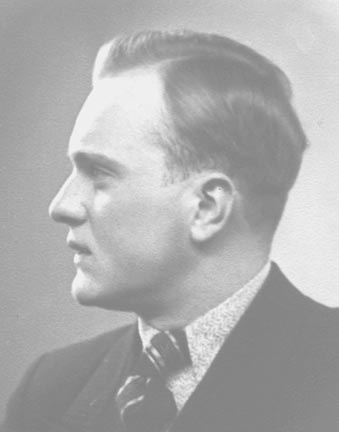 |
| Irmi's uncle |
| Hamburg, Germany (1939) |
| Ernst Walter Schulze (1916-1990) |
| Growing up the only son of a village butcher, Ernst had hoped to become a "master meat cutter" like his father and someday |
| assume the family business. In the late 1930's, he moved to the large northern city of Hamburg and began an apprenticeship |
| program as a meat cutter; but World War II intervened, and young Ernst soon found himself serving as an anti-aircraft gunner |
| in North Africa. In early 1942, while on furlough, he married the former Marie Götsch, a local woman he had met in Hamburg. |
| Late that year, Marie gave birth to a daughter, Bärbel. Before Ernst had met his daughter for the first time, he was captured |
| at the battle of Tobruk in 1943 and sent to the United States as a prisoner of war. At Fort Knox, Kentucky, he became the |
| personal driver for a U.S. Army colonel, based largely on the fact that he spoke excellent English, which he had learned as a |
| youth in school. Working as a driver allowed Ernst a relative wide range of freedom for a prisoner; and, as he moved among |
| the American people, he developed a strong affinity for their character and lifestyle. In late 1946, he found himself transferred |
| to England and, one year after that, finally repatriated to Germany where he met his five-year-old daughter for the first time. |
| The family settled in a small town near Hamburg where his wife had been raised, and Ernst resumed his trade as a butcher. |
| A son, Rainer, was born in 1952; and, not long afterward, Ernst finally became a "master meat cutter" like his father. Since |
| the family butcher shop in Gera had been confiscated by communist authorities, Ernst spent his entire career working for a |
| large meatpacking company in Hamburg. In 1990, when Ernst learned that his niece, Irmhild, would marry an American, he |
| became excited and planned to attend the event at Stuttgart in September. Sadly, he died three months before the wedding. |