|
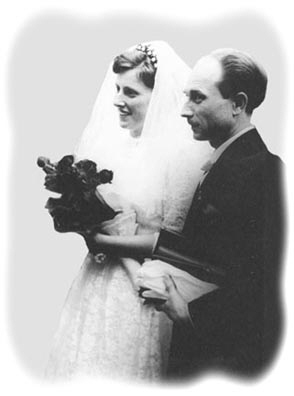 |
| Irmi's aunt and uncle |
| Gerlingen, Germany (1961) |
| Left: Margarete (Staiger) Scharna (1931) |
| Right: Lothar Siegfried Scharna (1925-2015) |
| During World War II, Lothar served in France and became a prisoner of war there from August, 1944, through April, 1949. |
| During his interment, the geographic landscape of his native Germany had changed drastically. His home of Forsthausen |
| and the whole of East Prussia had been transferred to Polish control; and Gera, where his family had fled, now fell under |
| control of a communist East German regime. Neither location appealed to Lothar; so, once French authorities released |
| him, he traveled to West Germany. Soon after his arrival, however, he was diagnosed with tuberculosis and spent a year |
| recuperating in a hospital in Fürth, near Nürnberg. Once his health returned, Lothar applied to several universities, hoping |
| to become a teacher like his father; unfortunately, due to his history with a contagious disease, the bureaucracy forbade |
| it. So, from 1952 through 1955, Lothar studied at a small college in Dortmund and became a social worker. His first job |
| in that field brought him to the city of Stuttgart, in Baden Württemberg, where a colleague, Margarete Staiger, located a |
| room for him in the house next door to her parents' home in nearby Gerlingen. Lothar and Margarete, trained as a social |
| worker herself, spent each day together at the office and shared most evenings, as well. Gradually, their relationship took |
| a romantic turn, and they married in April, 1961. Settling into a new life, they raised two children: Ulrike (1962-2004) and |
| Hans-Joachim (1963). Margarete gave up her job to remain at home with the children, but Lothar continued to work as a |
| social worker for the city of Stuttgart until his retirement in 1990. In the spring of 1992, Lothar finally achieved, albeit on |
| a modest scale, his dream of becoming a teacher. From his father, a country schoolmaster, Lothar had gained a deep |
| respect and clear understanding of the complex structure and often convoluted rules associated with German grammar; |
| and this he generously shared with his niece Irmhild's American husband each and every Wednesday afternoon for a full |
| year-and-a-half, as the bewildered younger man struggled mightily to comprehend the vagaries of the Teutonic tongue. |